
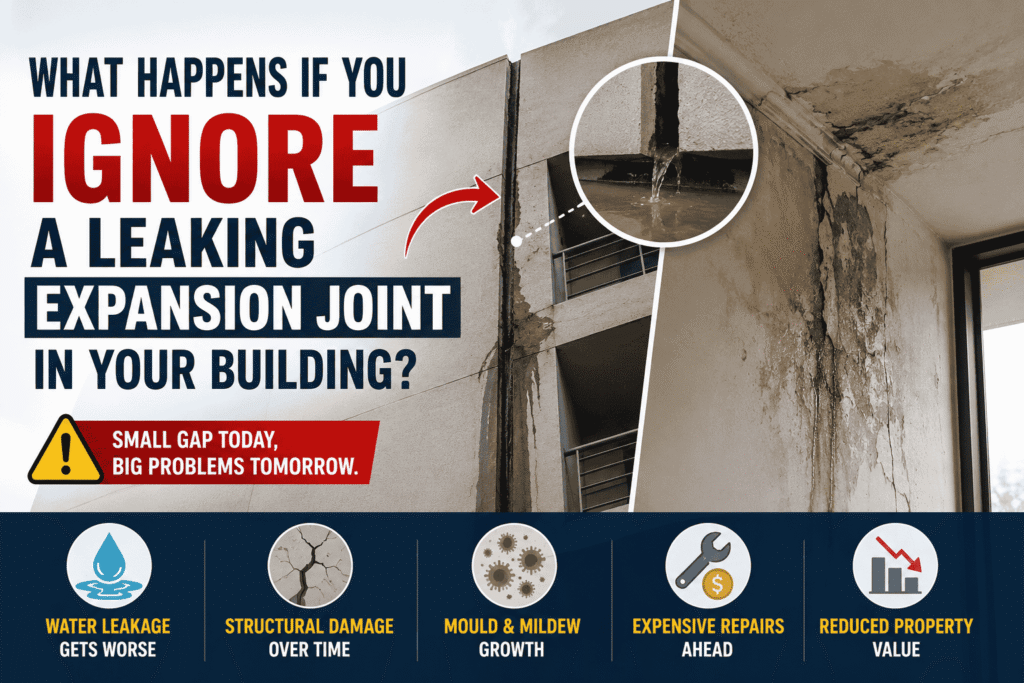
Most building owners focus on visible problems. A cracked wall. A leaking roof. A broken pipe. These are easy to see and hard to ignore.
But there is one problem that almost always gets ignored, even though it can cause serious damage over time.
It is a leaking expansion joint.
Most people have never heard of it. Some have seen it but did not know what it was. And almost everyone underestimates how dangerous an ignored expansion joint leak can be.
This blog explains what expansion joints are, why they leak, and what really happens when you choose to do nothing about it.
What Is an Expansion Joint?
Let us start from the beginning.
Buildings are not completely rigid. Concrete expands when it gets hot and contracts when it cools down. Large structures like multi-storey buildings, parking lots, terraces, and bridges go through this expansion and contraction every single day as temperatures change.
If a building were built as one solid block of concrete, this constant movement would cause massive cracks throughout the structure.
To prevent this, builders deliberately leave small gaps at regular intervals in the structure. These gaps are called expansion joints. They allow different sections of the building to move slightly without cracking.
Think of them as breathing spaces for the building.
These joints are usually sealed with flexible material to keep water out. But over time, that sealant breaks down. And when it does, water gets in.
Where Are Expansion Joints Found?
Expansion joints are present in many parts of a building. You may have walked past them hundreds of times without noticing.
Common locations include:
- Terrace and rooftop floors
- Basement walls and floors
- Parking deck surfaces
- External walls of large buildings
- Staircase slabs
- Podium slabs between towers in a housing society
In most buildings, these joints are covered with a sealant or a metal strip. When the sealant cracks or the strip lifts, the joint is exposed. And an exposed joint during rain is an open invitation for water.
Why Do Expansion Joints Start Leaking?
There are several reasons why expansion joint sealants fail over time:
Age: Most sealants have a lifespan of 5 to 10 years. After that, they harden, crack, and lose their flexibility.
UV exposure: Sunlight breaks down rubber and silicone sealants on terraces and external walls.
Poor original installation: If the wrong type of sealant was used during construction, it may fail within just a few years.
Structural movement: If there is more movement in the building than expected, due to soil settling or heavy loads, the sealant can pull away from the edges.
Water pressure: In basements, water pressure from outside the structure can push through even small gaps.
Once the sealant is gone, the joint is no longer waterproof. Rain, groundwater, or even cleaning water can enter freely.
What Happens When You Ignore It?
This is the part that most building owners do not realise until it is too late.
An ignored expansion joint leak does not stay the same. It gets worse. And the damage it causes spreads far beyond the joint itself.
Here is a timeline of what typically happens:
Stage 1: Minor Seepage (Early Months)
At first, you may notice small damp patches near the joint area. Maybe a slight discolouration on the wall or floor nearby. This stage feels harmless. Many people assume it will dry up on its own.
It will not.
Stage 2: Water Enters the Structure (3 to 12 Months)
Water now travels through the gap regularly. It enters the slab and begins moving through the concrete. You may start seeing:
- Water stains on walls and ceilings near the joint
- White salt deposits (efflorescence) forming on the surface
- Peeling paint or plaster falling off
At this stage, the damage is spreading but can still be repaired at reasonable cost.
Stage 3: Steel Reinforcement Begins to Rust (12 to 36 Months)
This is where things get serious.
Concrete buildings are held together by steel rebar inside the concrete. Water that reaches the steel causes rust. Rust makes the steel expand. This expansion creates pressure from inside the concrete and causes it to crack and break apart, a process called concrete spalling.
You will see chunks of concrete falling off walls and ceilings. The cracks get bigger. The damage becomes structural.
Stage 4: Structural Weakening (Beyond 3 Years)
At this stage, the building’s strength is compromised. The repair costs are now very high. In serious cases, entire sections of the slab or column may need to be rebuilt. This is not a waterproofing job anymore, it becomes a structural restoration project.
And all of this started from a small, ignored gap.
The Cost of Waiting vs The Cost of Acting Early
Here is a simple comparison to show why early action always makes sense:
| Timeline | Condition | Estimated Repair Cost |
|---|---|---|
| Within 1 year | Sealant replacement only | Low |
| 1 to 2 years | Sealant plus grouting to stop active seepage | Moderate |
| 2 to 4 years | Grouting plus structural plaster repair | High |
| Beyond 4 years | Structural restoration, rebar treatment | Very High |
The longer you wait, the more expensive and disruptive the repair becomes.
How Is a Leaking Expansion Joint Fixed?
The most effective modern solution for leaking expansion joints, especially in basements, terraces, and parking areas, is Polyurethane (PU) Injection Grouting.
Here is why it works so well:
PU grout is injected directly into the joint and into the surrounding concrete. When it comes into contact with water or moisture, it expands and forms a dense, flexible foam. This foam fills every gap, crack, and channel in the joint area.
The result is a watertight seal that:
- Bonds with the concrete from the inside
- Remains flexible, so it moves with the building during expansion and contraction
- Works even when there is active water flow through the joint
- Requires no demolition or major surface work
This is exactly why PU grouting is the preferred method for expansion joint repairs in multi-storey buildings, basements, and parking structures.
At Hallmark Waterproofing Solutions, the team handles leaking expansion joints using PU injection grouting with precision. Before any grouting begins, the joint is inspected thoroughly to understand the extent of seepage and the right injection points are marked. This step-by-step approach ensures the repair reaches the right depth and covers the full length of the affected joint.
How to Know If Your Building Has a Leaking Expansion Joint
You do not need to be a structural engineer to spot the early signs. Watch for:
- Damp patches appearing along a straight line on walls or floors
- Water entry during or after rain near a building joint or seam
- White powdery deposits along a joint line
- Rust stains running vertically down a wall
- Concrete chunks or plaster falling near a joint area
If you see any of these signs, it is worth calling a professional for an inspection. The earlier you catch it, the simpler and cheaper the fix.
Final Thought
Expansion joints are built into your structure to protect it. But when they fail, they become the very path that destroys it.
Ignoring a leaking expansion joint is not saving money. It is borrowing time at a very high interest rate.
If you have seen any of the warning signs in your building, whether it is a housing society, a commercial property, or a standalone home, do not put it off. Get it looked at early.
The team at Hallmark Waterproofing Solutions specialises in diagnosing and fixing expansion joint leaks using PU injection grouting. If you are in Navi Mumbai or nearby, reach out for an inspection before a small gap becomes a big problem.